Sunday, June 14, 2015

Homework for English Language Learners

RATIONALE:

Homework is an opportunity for students to practice, review, and apply knowledge (Hill, 2006).  It is an opportunity to extend learning beyond the school day, and solidify learning that took place at school. Research shows that students need to practice a skill or process at least 24 times to obtain 80 percent proficiency, so homework provides additional opportunities for practice (Hill, 2006).  It is particularly important for English Language Learners to have homework to practice skills because they may need even more focused practice than English-dominant students. 

Not only will homework provide the focused practice students need to deepen their understanding of content and become proficient in skills, but it will also help students develop good study habits (
Colorín Colorado, 2007).  Homework provides children with opportunities to practice managing their time and meeting deadlines (U.S. Department of Education, 2005).  Furthermore, homework builds communication between school and home.  Families can keep up with what students are learning and school and receive feedback on homework assignments the student turns in (U.S. Department of Education, 2005).

Above all, homework helps a student’s achievement in school.  When students are assigned meaningful homework, turn it in successfully completed, and read the constructive feedback left by the teacher their performance in school improves (U.S. Department of Education, 2005). Studies show that students who complete more homework score better on standardized tests and earn better grades than students who do less homework (U.S. Department of Education, 2005).  

MEANINGFUL HOMEWORK & OBJECTIVES:

In order for homework to serve its purpose, it must be meaningful.  Meaningful homework provides direct opportunities to apply knowledge and skills that were taught in class (Hill, 2006).  The purpose of homework will be to practice skills learned in class, develop fluency with skills, and build confidence (U.S. Department of Education, 2005).  Homework will be directly tied to what is being worked on in the classroom, and will be at a student’s independent level so that they can complete it without assistance.  In order to keep homework at independent work levels students might receive homework that is different than the work of their peers, but this difference will be discrete so no one notices. 
  
Homework is…
Homework is not…
  • An opportunity to apply knowledge learned in class
  • An opportunity to practice or review skills taught in class
  • Reinforcement of concepts taught at school
  • Work to be done independently
  • Used to extend learning
  • Used to complete activities and assignments started at school
  • A way to foster a partnership between school and home
  • Used to promote time management skills

  • Busy work
  • Used for learning new topics
  • Work that parents to need to provide assistance with
  • Work that is too hard to complete independently


FEEDBACK & OVERCOMING BARRIORS:

Constructive feedback will be provided on homework assignments.  If comments are not left on homework they will be communicated verbally to the child.  Parental involvement in homework should be minimal, however there may occasionally be times where for whatever reason a student struggles.  In these situations students will be given additional instruction at school.  During the “What I Need” slot of the day students will be provided additional assistance on any homework assignments they were unable to understand.  These avenues of feedback will ensure that students understand the homework even if they were not completely successful on the first try. 

Occasionally obstacles may exist when establishing communication with families of English Language Learners.  First, it is important to establish and clearly communicate homework policies.  In addition, it is crucial that families are informed that the best way that they can help with homework is to provide the time and space for students to complete work.  Family members can be role models of achievement and help instill good study habits by making homework and education a priority (Colorín Colorado, 2007).  It is also important to communicate with parents that homework should require minimal assistance on their part, and that they should contact the teacher any time there are issues.  Lastly, technology can be used as a translator for homework policies and feedback.  If the parents do not speak English then a school translator or Google translator can be used to translate homework comments and any other necessary information. 

Resources

Colorín Colorado. (2007). Empowering hispanic parents & families at home | Colorín Colorado. Retrieved June 14, 2015, from http://www.colorincolorado.org/educators/reachingout/empowering/


Hill, J., & Flynn, K. (2006). Classroom instruction that works with English language learners. Alexandria, VA: Association for Supervision and Curriculum Development.

U.S. Department of Education. (2005). Homework: the basics. Retrieved June 14, 2015, from http://www.colorincolorado.org/article/20469/


Friday, June 5, 2015

Non-fiction and Fiction Texts for English Language Learners

Presenting students with a variety of texts is crucial to prepare them to read all genres.  Both fiction and non-fiction texts should be integrated into classroom instruction and independent reading.  However, many English Language Learners could struggle without the right instruction to support their reading.  There are many important differences to keep in mind when analyzing fiction and non-fiction texts for the classroom.  This week I selected samples of both fiction and non-fiction texts appropriate for the students I worked with to determine the important differences to keep in mind when it comes to using each genre with English Language Learners.  This graphic organizer can be used as a reference to prepare appropriate scaffolding when selecting texts for instruction for English Language Learners.


Fiction
Non-fiction
Types of Texts Sampled
  • Storia texts with Lexiles 700-800
  • Treasures Leveled Texts
  • Books from Classroom Library

  • Discovery Education Reading Passages and E-books
  • Nonfiction Books on Storia
  • Treasures Leveled Texts
  • Passages on Time for Kids and Newsela
  • Textbooks

Levels
Fourth
Fourth
Features that Might Help ELL Students
  • Drawings and Illustrations
  • Predictable Plot: Beginning, Middle, and End
  • Dialogue and Conversation
  • Often includes Familiar Vocabulary
  • Storyline is Occasionally Predictable
  • Synopsis

  • Real Photographs, Images
  • Charts, Graphs, Maps, Graphic Organizers
  • Headings that Clarify each Section
  • Summaries in Introduction and/or Conclusion
  • Glossary
  • Index
  • Table of Contents
  • Foreward
  • Text structure
  • Appendix
  • Captions

Features that Might Challenge ELL Students
  • Unfamiliar Vocabulary
  • Cultural Elements Not Familiar to the Student
  • Slang
  • Theme

  • Technical language on the topic
  • New and often difficult vocabulary
  • Organization of Information
  • No Background Knowledge on the Topic


After analyzing both genres, I came to the conclusion that I do not believe that one genre is more challenging than the other.  It all just depends on the child’s background knowledge, the level of the text, and the scaffolds that are put into place.  I believe that with the right instruction English Language Learners can succeed with either genre if they are interested in the text, engaged during reading, and motivated to succeed.

Technology for English Language Learners

Tech for ELLs Symbaloo: http://edu.symbaloo.com/shared/AAAAAcRJ7BgAA41-4VxCMg==

Monday, June 1, 2015

Sheltered Instruction Observation Protocal

The SIOP method, Sheltered Instruction Observation Protocal, makes learning accessible to English Language Learners.  The SIOP method provides scaffolding that allows all students to be successful in the classroom.  Below you will find my observations and thoughts on the recorded SIOP lesson provided by Regis.

Before Reading
Strategy
Teacher Action
Student Action
Comments
Set clear expectations and provided an outline of what would happen in the lesson.
The teacher explicitly explained the lesson.  She went over objectives verbally, but also had them written down. The teacher made the students feel more comfortable and worked to take away anxiety.
Students reviewed expectations for the day.  They were following along as the teacher went over what would happen in the lesson.  
The teacher clearly outlined the agenda for the lesson, and shared goals with students.  It seemed that students were more relaxed knowing exactly what was expected of them.
Reminded students of the reading strategies they should focus on using.
The teacher explained that the goal would be to focus on inferences.  She said that she wants students to begin to understand how to make inferences.  She then said she wanted to review reading strategies.  She asked students questions about what kind of strategies they have learned that they would need today.
Students answered the teacher's questions about what reading strategies they should be using.
The teacher reviewed the focus for the day, which allows ELLs to focus on the important goals of the lesson.
Previews key vocabulary from chapter
 The teacher has pictures for students to look at and pass down the row.   She then discusses the meaning of each of the words, and references the pictures when speaking about each words.  She points out obscurities in spelling.  She tells stories to build connections to the words.  Occasionally she uses synonyms to help students understand the meanings of the words.  She also uses the students' native language to build connections with vocabulary words.
The students answered the teacher's questions.   They provided connections to words. They shared the names of words in their first language.  
The teacher used pictures, words, verbal definitions, and stories to build vocabulary knowledge.  Students shared names of the words in their first language, and were engaged in the vocabulary discussion.
Makes connections to culture
The teacher links the lesson to students' background experiences by inviting the students to talk to their parents about superstitions in their culture.
Students listened, but would need to take action on this connection once they are home.
The teacher worked to make connections to culture.  Furthermore, the teacher has increased language output if students do in fact go home and talk to their family about superstitions. 
During Reading
Strategy
Teacher Action
Student Action
Comments
Clear Directions
The teacher sheltered the directions and made sure students knew exactly what to do.  She asked students if they understood where they were starting.
Students found the necessary page, and confirmed that they knew where they were beginning the lesson.
It is important that all students are following along and know what is expected of them.  The teacher set all students up for success by making sure they were in the right place at the right time.  All students quickly found the page, and were ready to learn.
Reading aloud
The teacher read clearly, slowly, and with correct pronunciation so students could understand and follow along.
Students followed along as the text was being read aloud.
The teacher helped students with word recognition by reading clearly and at a speed that students could follow.  The students can then see and hear the words at the same time.  The teacher was clear, and all students were following along.
Explicit Instruction on Strategies
The teacher providing scaffolding by reminding the students how to use strategies, asking questions, and guiding them towards making an inference.  She took notes in front of the class and reminded students to use background knowledge.
Students answered questions, participated in discussions, and wrote down clues to help make inferences. 
The teacher did an excellent job providing wait time, scaffolding, and modeling to support student thinking.
Repetition of Key Vocabulary
The teacher pointed out words that were already covered at the beginning of the lesson to solidify knowledge of the words.
Students listened to the repeated explanation of the vocabulary words.
Repetition is important to acquisition of vocabulary for ELLs.  She used a variety of methods to introduce the vocabulary, but confirming the meanings of the words here ensured the words were committed to memory.
After Reading
Strategy
Teacher Action
Student Action
Comments
Review Content, Strategies, and Allow Students to Interact with Text Individually
The teacher sheltered instructions for the review.  The instructions were explained, and written on the board for reference.  She asked the students to complete specific tasks on their Post-It notes for review.
Students listened to instructions, referenced the instructions on the board, and started to work independently.
The teacher did a great job providing an opportunity to interact with the text individually so that they are able to continue to construct meaning with multiple exposures to the text.

The SIOP model is excellent for instructing English Language Learners.  The teacher in this video was very intention with her use of strategies.  It was very clear that she had thought through what she was teaching and the students she was teaching.  She did not “dumb down” the lesson or just seek out an easier text.  Instead, she provided the necessary scaffolding so that students could focus on their learning and be successful in doing so.  

Tuesday, May 26, 2015

Running Record & Miscue Analysis of Two English Language Learners

A running record combined with a miscue analysis is a powerful assessment tool.  The information obtained from completing a running record is valuable data that can be used to drive instruction.  Furthermore, a running record gives a better-rounded picture of a student’s abilities rather than just relying on computerized assessments.  This week I assessed two English Language Learners using this valuable assessment tool.

The first ELL student I tested was Armando.  His primary language at home is Spanish.  Armando is a fourth grade student who enjoys speaking with his friends, but is very quiet around teachers.  This year is Armando’s first year at our school, he came to use due to moving into our enrollment area.  Armando is a very bright student, but not very motivated to complete his work independently.  Unless an adult is sitting near him, he does not complete his work.  Armando also struggles to turn in his work or read at home.  During the fall semester mom supported sending him to our free after school homework club, and Armando really benefited from the extra support.  His test scores and in class performance showed his new found confidence with his academic stills, but due to a change in mom’s schedule, Armando was unable to take advantage of another semester of homework club.  Based on Armando’s previous assessment data including DIBELS, MAPS, STAR, and in classroom observations I know Armando is reading on a fourth grade level.  Therefore, I decided to test him on a fifth grade passage in order to identify next steps for support.

The second ELL student I tested was Luca.  Luca is a fourth grade student in my colleague’s class.  Luca’s family speaks German at home.  Luca is very dedicated towards his studies.  In addition, he is a very outgoing kid who loves recess and playing with his friends.  Luca’s teacher has informed me that Luca is reading fluently at a fourth grade level, and that she would love for me to assess him on a fifth grade level so that she can communicate the results to his parents.  Luca’s parents are planning to try to work with him this summer, so this would be valuable information that she can pass along to the family.  Luca has been very lucky to have parents support him in his development.

I was very glad to be able to give the same running record assessment.  This seemed like the best scenario for me to be able to determine if I could correlate a connection between errors and first languages.  I gave both students a Level X passage entitled, Many Happy Returns by Marilyn Gould, found on Reading A-Z.  

Armando’s reading was slow and choppy.  He does not read with much expression, and it is clear that this impacts his comprehension.  When Armando came to a word he did not know he used several strategies to help him decode the words.  He reread the words, sounded them out, and used pictures when they were available to determine meaning.  He read slowly to correctly decode words, and when he made a mistake he went back to fix it.  Armando self-corrected the majority of his errors.  Armando’s retell was very brief, and it was clear that his comprehension was hindered by how much energy he had to focus on decoding the text.  I also believe that Armando’s retell was affected by the way he interacts with adults.  Armando is very talkative with his friends, but quiet around adults.  Armando did not elaborate when retelling the story.  I aided his retell a few times by asking additional questions, but the responses I received were also very short and limited.  Overall, Armando comprehended the story, but was very limited in the details he provided.  Armando’s pronunciation was influenced by his native language, but I could not determine that any of his miscues were directly related to his native language.

Luca read most of the passage with expression and intonation.  He was very confident in his abilities to read the text.  However, I often found that his mistakes were due to reading too fast.  I believe that Luca could benefit from being taught to vary his reading speeds to correctly convey meaning, and read more accurately.  After analyzing Luca’s errors I do not believe the errors he made reflect his native language.  Based on my experience reading with Luca, and what his teacher says about his classroom performance I believe many of his errors were due to trying to read the text too quickly.  Mrs. Merry tells me that she frequently has to remind Luca to slow down and take his time.  Since Luca was able to successfully retell the story I could also that his comprehension was not hindered by his errors.

Teaching Points Based on Running Records

Running records provide a wealth of information that can be used to directly plan strategy instruction for students.  Based on my findings from the running records I believe that both boys could benefit from instruction in both fluency and comprehension. 

Armando could benefit from instruction focused on his retell abilities.  I believe that instructing Armando on his retell abilities would assist in his ability to retell details, and ultimately help in his overall comprehension of the passage.

For both boys, I see that next steps to improve their reading ability would be to provide fluency instruction.  Armando’s reading was slow and choppy, while Luca’s reading was occasionally rushed.  I believe both boys could benefit from practicing fluent reading.  Models of fluent reading, either from a peer or teacher, would help these boys learn appropriate pacing.  Armando needs additional help reading with intonation.  Armando’s reading is very monotone, and reading with expression will help him better understand the text he is approaching.

In addition, both students could also benefit from instruction in prereading strategies to help them activate background knowledge.  Using this information and the miscue analysis of the types of errors, I know the boys relied too heavily on just the graphophonic cues.  I believe both boys would benefit from previewing the text, and set a purpose for reading.  If students come to a text with an idea of what they will be reading about then the reading becomes a much easier task (Gibbons, 2002).  If teachers utilize prereading strategies, and focus on constructing meaning then students can better utilize all three cueing systems instead of relying just on phonics (Freeman & Freeman, 2004).  Therefore, the data from this assessment suggests that both students could benefit from instruction that will help them make use of both the syntactic and semantic cues from the text as they read (Freeman & Freeman, 2004). 

Running records are powerful tools.  These authentic assessments provide such a wealth of information that can be used to directly plan instruction for students.  Not only do these assessments provide valuable information to drive instruction, but they are also great for documenting a child’s reading progress.

Resources

Freeman, D., & Freeman, Y. (2004). Written and Second Language Acquisition. In Essential linguistics: What you need to know to teach reading, ESL, spelling, phonics, and grammar. Portsmouth, NH: Heinemann.

Gibbons, P. (2002). Scaffolding language, scaffolding learning: Teaching second language learners in the mainstream classroom. Portsmouth, NH: Heinemann.

Gould, M. (n.d.). Many happy returns. ReadingA-Z.com.

Saturday, May 16, 2015

How to Approach Written and Second Language Learning: Learning or Acquisition?

There is debate over written language and whether is it learned or acquired.  Beliefs regarding how written language and second languages develop affect the way a teacher teaches reading and writing (Freeman & Freeman, 2004).  Therefore, it is crucial to take a look at how these two develop, and the appropriate approaches to teaching reading and writing. There are two views of reading, the word recognition view and the sociopsycholinguistic view.  The word recognition view is that written language must be learned, and the sociopyscholinguistic view states that the ability to use written language is acquired (Freeman & Freeman, 2004).  There are also two views of writing.  The learning view says that writing must be directly taught, and the acquisition view is that writing is a form of output that reflects that language abilities a person has acquired (Freeman & Freeman, 2004).

Linguistics suggests that written and second languages are acquired rather than learned (Freeman & Freeman, 2004). Therefore, understanding that the acquisition/sociopsycholinguistic view is supported by research, and which types of learning activities align with these views is important.  This week's activity called for an in-depth look at each view and the activities that go along with the viewpoints.

Below, I have organized the activities provided by Freeman & Freeman as potential Learning or Acquisition approaches.  There are some activities that are considered to belong to both approaches. Explanations for choices are also included.


Learning/Word Recognition
Acquisition/Sociopsycholinguistic View
Both Types of Learning
Student
 - Look up words in the dictionary to write definitions.
- Practice sounding out words.
-Read in round-robin fashion.
-Ask the teacher how to spell any word that they don't know.
-Divide words into syllables.
-On a worksheet, draw a line from each word to the picture that starts with the same sound.

These choices align with the word recognition/learning view because the main task is identifying words.  Students are identifying words to comprehend a text.  Students study phonics rules to learn to sound out words (Freeman & Freeman, 2004).
 -Correct peers when they make mistakes during reading.
-Group cards with classmates' names by a criterion on such as first or last name.
-Write rhyming poetry and then discuss different spellings for the same sound.
-Read a language experience story they have created with the teacher.
-Work in pairs to arrange words from a familiar chant into sentences.
-Make alphabet books on different topics.

These choices all align with the acquisition/sociopsycholinguistic view because they focus on meaning. Students are constructing meaning by interacting with language. Students produce writing and knowledge of the writing process develops as they learn how to convey their message.  Students begin with messages, and then study skills (Freeman & Freeman, 2004).
-Make a Venn diagram to compare two stories.
Both the views include a long-term goal of being able to comprehend a text. This activity could be used from both viewpoints to construct meaning.
-Identify words on a big book page that start with the same sound.
This activity is skill based and deals with learning a specific sound as in the word recognition view.  Yet, it aligns with the sociopyscholinguistic view because students are interacting with text to acquire vocabulary.

Teacher
-Preteaches vocabulary.
-Has students segment words into phonemes.
-Uses decodable texts.
-Teaches Latin and Greek roots.
-Conducts phonics drills.
-Uses a variety of worksheets to teach different skills.

These choices align with the word recognition/learning view because the main task is identifying words.  Students are identifying words to comprehend a text.  They are studying skills and word parts to build meaning. Also, students study phonics rules to learn to sound out words (Freeman & Freeman, 2004).
-Does a shared reading with a big book.
-Writes words the students dictate for a story and has students help with the spelling of difficult words.
-Asks students to look around the room and find words starting with a certain letter.
-Sets aside time for SSR.
-Has students meet in literature circles.
-Does a picture walk of a new book.
-Teaches students different comprehension strategies.  

These items all align with the acquisition/sociopsycholinguistic view because they focus on meaning. Students are constructing meaning by interacting with language. Students produce writing and knowledge of the writing process develops as they learn how to share their message. These also align because student have time to read silently and use strategies to construct meaning for a text (Freeman & Freeman, 2004). 
-Makes sure that students read only books that fit their level.
-Chooses predictable texts.
Both viewpoints have a goal of comprehending texts, and in order to comprehend a text it must not be too difficult.  Therefore, these two strategies could fit in both viewpoints because students would get to construct meaning at an appropriate level.


Freeman, D., & Freeman, Y. (2004). Written and Second Language Acquisition. In Essential linguistics: What you need to know to teach reading, ESL, spelling, phonics, and grammar. Portsmouth, NH: Heinemann.

Sunday, May 10, 2015

Children’s Books and Components that Affect Comprehension

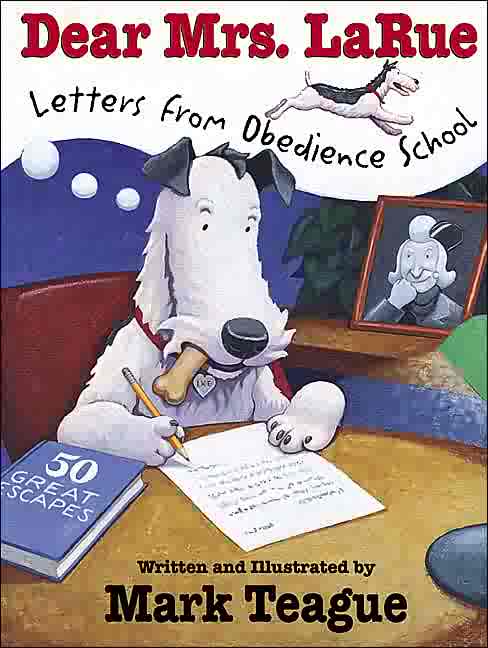
When evaluating children’s books it is important for teachers to keep in mind that some English Language Learners might lack the background knowledge necessary for understanding texts.  This week I evaluated The True Story of the Three Little Pigs by Jon Scieszka and Dear Mrs. LaRue Letters from Obedience School by Mark Teague. Each book was evaluated for components that might affect comprehension.


Dear Mrs. LaRue Letters from Obedience School by Mark Teague

1.      Difficulty: The student might not understand the format of the book.  English Language Learners may be confused that it is not written in a typical story format.  Also, they may not be familiar with written correspondence. 
Solution: The teacher can explain that this book is not written in the same format of a typical story.  The teacher can show the students that even though the text is written using letters, it still tells a story.
2.      Difficulty: English language learners may not have background knowledge of obedience school or prisons.  They may struggle with the concept of sending a dog off to an “academy”.
Solution: The teacher can pre-teach the concept of boarding schools.  The teacher can explain the use of boarding schools as well as animal obedience schools.
3.      Difficulty: ELL students may struggle to identify that Ike is exaggerating.  Ike says one thing, but the pictures show another. 
Solution:  Teachers can help English Language Learners see that Ike is being dramatic by pointing out the differences between the pictures and Ike’s letters.  The use of visuals and the teacher thinking aloud will help students understand the differences.  Furthermore, conversation with a partner about Ike’s letters and conditions would help develop language and understanding.
4.      Difficulty: Some ELL students may have difficulty separating the real and imaginary elements of the story.
Solution: Help students see how the author blends behaviors or real dogs into an imaginary story.  The teacher can help students separate the behavior of real dogs and make-believe dogs.  This can be done with the use of a graphic organizer on the board that is filled out throughout and after the story.  A teacher could also use a video to show typical dog behaviors.
The True Story of the Three Little Pigs by Jon Scieszka

1.      Difficulty: If English Language Learners do not know the story of the three little pigs then they will struggle to understand The True Story of the Three Little Pigs or the significance of the story.
Solution: Teachers can be sure to give the opportunity to read the original The Three Little Pigs story before The True Story of the Three Little Pigs.
2.      Difficulty: English Language Learners might not understand the concept of a fractured fairy tale.
Solution: After ensuring that all students have read the original The Three Little Pigs, teach students about fractured fairy tales.  Teachers should be sure to explain that the changes in The True Story of the Three Little Pigs makes it a fractured fairy tale.
3.      Difficulty: Students may understand some of the vocabulary and phrases used in the story.  Phrases: rude little porker, what a pig, brains of the family, your old granny can sit on a pin, jazzed the story up, the big bad wolf, once upon a time time, jazz it up, and second helping.
Words: framed, huffed, puffed, cheeseburger, and spoil
Solution: Pre-teach these unfamiliar phrases using pictures and demonstrations prior to reading, and reiterate meanings as necessary during reading.
4.      Difficulty: English Language Learners might not understand that straw and sticks are not good building materials for a house. 
Solution: A teacher could set up a mock demonstration showing the strength of straw and sticks.  As an alternative, the teacher could have straw, sticks, and a brick to illustrate the differences between the building materials.


References
Scieszka, J. (1989). The true story of the 3 little pigs. New York, NY: Viking Kestrel.
Teague, M. (2002). Dear Mrs. LaRue: Letters from obedience school. New York, NY: Scholastic Press.