Tuesday, May 26, 2015

Running Record & Miscue Analysis of Two English Language Learners

A running record combined with a miscue analysis is a powerful assessment tool.  The information obtained from completing a running record is valuable data that can be used to drive instruction.  Furthermore, a running record gives a better-rounded picture of a student’s abilities rather than just relying on computerized assessments.  This week I assessed two English Language Learners using this valuable assessment tool.

The first ELL student I tested was Armando.  His primary language at home is Spanish.  Armando is a fourth grade student who enjoys speaking with his friends, but is very quiet around teachers.  This year is Armando’s first year at our school, he came to use due to moving into our enrollment area.  Armando is a very bright student, but not very motivated to complete his work independently.  Unless an adult is sitting near him, he does not complete his work.  Armando also struggles to turn in his work or read at home.  During the fall semester mom supported sending him to our free after school homework club, and Armando really benefited from the extra support.  His test scores and in class performance showed his new found confidence with his academic stills, but due to a change in mom’s schedule, Armando was unable to take advantage of another semester of homework club.  Based on Armando’s previous assessment data including DIBELS, MAPS, STAR, and in classroom observations I know Armando is reading on a fourth grade level.  Therefore, I decided to test him on a fifth grade passage in order to identify next steps for support.

The second ELL student I tested was Luca.  Luca is a fourth grade student in my colleague’s class.  Luca’s family speaks German at home.  Luca is very dedicated towards his studies.  In addition, he is a very outgoing kid who loves recess and playing with his friends.  Luca’s teacher has informed me that Luca is reading fluently at a fourth grade level, and that she would love for me to assess him on a fifth grade level so that she can communicate the results to his parents.  Luca’s parents are planning to try to work with him this summer, so this would be valuable information that she can pass along to the family.  Luca has been very lucky to have parents support him in his development.

I was very glad to be able to give the same running record assessment.  This seemed like the best scenario for me to be able to determine if I could correlate a connection between errors and first languages.  I gave both students a Level X passage entitled, Many Happy Returns by Marilyn Gould, found on Reading A-Z.  

Armando’s reading was slow and choppy.  He does not read with much expression, and it is clear that this impacts his comprehension.  When Armando came to a word he did not know he used several strategies to help him decode the words.  He reread the words, sounded them out, and used pictures when they were available to determine meaning.  He read slowly to correctly decode words, and when he made a mistake he went back to fix it.  Armando self-corrected the majority of his errors.  Armando’s retell was very brief, and it was clear that his comprehension was hindered by how much energy he had to focus on decoding the text.  I also believe that Armando’s retell was affected by the way he interacts with adults.  Armando is very talkative with his friends, but quiet around adults.  Armando did not elaborate when retelling the story.  I aided his retell a few times by asking additional questions, but the responses I received were also very short and limited.  Overall, Armando comprehended the story, but was very limited in the details he provided.  Armando’s pronunciation was influenced by his native language, but I could not determine that any of his miscues were directly related to his native language.

Luca read most of the passage with expression and intonation.  He was very confident in his abilities to read the text.  However, I often found that his mistakes were due to reading too fast.  I believe that Luca could benefit from being taught to vary his reading speeds to correctly convey meaning, and read more accurately.  After analyzing Luca’s errors I do not believe the errors he made reflect his native language.  Based on my experience reading with Luca, and what his teacher says about his classroom performance I believe many of his errors were due to trying to read the text too quickly.  Mrs. Merry tells me that she frequently has to remind Luca to slow down and take his time.  Since Luca was able to successfully retell the story I could also that his comprehension was not hindered by his errors.

Teaching Points Based on Running Records

Running records provide a wealth of information that can be used to directly plan strategy instruction for students.  Based on my findings from the running records I believe that both boys could benefit from instruction in both fluency and comprehension. 

Armando could benefit from instruction focused on his retell abilities.  I believe that instructing Armando on his retell abilities would assist in his ability to retell details, and ultimately help in his overall comprehension of the passage.

For both boys, I see that next steps to improve their reading ability would be to provide fluency instruction.  Armando’s reading was slow and choppy, while Luca’s reading was occasionally rushed.  I believe both boys could benefit from practicing fluent reading.  Models of fluent reading, either from a peer or teacher, would help these boys learn appropriate pacing.  Armando needs additional help reading with intonation.  Armando’s reading is very monotone, and reading with expression will help him better understand the text he is approaching.

In addition, both students could also benefit from instruction in prereading strategies to help them activate background knowledge.  Using this information and the miscue analysis of the types of errors, I know the boys relied too heavily on just the graphophonic cues.  I believe both boys would benefit from previewing the text, and set a purpose for reading.  If students come to a text with an idea of what they will be reading about then the reading becomes a much easier task (Gibbons, 2002).  If teachers utilize prereading strategies, and focus on constructing meaning then students can better utilize all three cueing systems instead of relying just on phonics (Freeman & Freeman, 2004).  Therefore, the data from this assessment suggests that both students could benefit from instruction that will help them make use of both the syntactic and semantic cues from the text as they read (Freeman & Freeman, 2004). 

Running records are powerful tools.  These authentic assessments provide such a wealth of information that can be used to directly plan instruction for students.  Not only do these assessments provide valuable information to drive instruction, but they are also great for documenting a child’s reading progress.

Resources

Freeman, D., & Freeman, Y. (2004). Written and Second Language Acquisition. In Essential linguistics: What you need to know to teach reading, ESL, spelling, phonics, and grammar. Portsmouth, NH: Heinemann.

Gibbons, P. (2002). Scaffolding language, scaffolding learning: Teaching second language learners in the mainstream classroom. Portsmouth, NH: Heinemann.

Gould, M. (n.d.). Many happy returns. ReadingA-Z.com.

Saturday, May 16, 2015

How to Approach Written and Second Language Learning: Learning or Acquisition?

There is debate over written language and whether is it learned or acquired.  Beliefs regarding how written language and second languages develop affect the way a teacher teaches reading and writing (Freeman & Freeman, 2004).  Therefore, it is crucial to take a look at how these two develop, and the appropriate approaches to teaching reading and writing. There are two views of reading, the word recognition view and the sociopsycholinguistic view.  The word recognition view is that written language must be learned, and the sociopyscholinguistic view states that the ability to use written language is acquired (Freeman & Freeman, 2004).  There are also two views of writing.  The learning view says that writing must be directly taught, and the acquisition view is that writing is a form of output that reflects that language abilities a person has acquired (Freeman & Freeman, 2004).

Linguistics suggests that written and second languages are acquired rather than learned (Freeman & Freeman, 2004). Therefore, understanding that the acquisition/sociopsycholinguistic view is supported by research, and which types of learning activities align with these views is important.  This week's activity called for an in-depth look at each view and the activities that go along with the viewpoints.

Below, I have organized the activities provided by Freeman & Freeman as potential Learning or Acquisition approaches.  There are some activities that are considered to belong to both approaches. Explanations for choices are also included.


Learning/Word Recognition
Acquisition/Sociopsycholinguistic View
Both Types of Learning
Student
 - Look up words in the dictionary to write definitions.
- Practice sounding out words.
-Read in round-robin fashion.
-Ask the teacher how to spell any word that they don't know.
-Divide words into syllables.
-On a worksheet, draw a line from each word to the picture that starts with the same sound.

These choices align with the word recognition/learning view because the main task is identifying words.  Students are identifying words to comprehend a text.  Students study phonics rules to learn to sound out words (Freeman & Freeman, 2004).
 -Correct peers when they make mistakes during reading.
-Group cards with classmates' names by a criterion on such as first or last name.
-Write rhyming poetry and then discuss different spellings for the same sound.
-Read a language experience story they have created with the teacher.
-Work in pairs to arrange words from a familiar chant into sentences.
-Make alphabet books on different topics.

These choices all align with the acquisition/sociopsycholinguistic view because they focus on meaning. Students are constructing meaning by interacting with language. Students produce writing and knowledge of the writing process develops as they learn how to convey their message.  Students begin with messages, and then study skills (Freeman & Freeman, 2004).
-Make a Venn diagram to compare two stories.
Both the views include a long-term goal of being able to comprehend a text. This activity could be used from both viewpoints to construct meaning.
-Identify words on a big book page that start with the same sound.
This activity is skill based and deals with learning a specific sound as in the word recognition view.  Yet, it aligns with the sociopyscholinguistic view because students are interacting with text to acquire vocabulary.

Teacher
-Preteaches vocabulary.
-Has students segment words into phonemes.
-Uses decodable texts.
-Teaches Latin and Greek roots.
-Conducts phonics drills.
-Uses a variety of worksheets to teach different skills.

These choices align with the word recognition/learning view because the main task is identifying words.  Students are identifying words to comprehend a text.  They are studying skills and word parts to build meaning. Also, students study phonics rules to learn to sound out words (Freeman & Freeman, 2004).
-Does a shared reading with a big book.
-Writes words the students dictate for a story and has students help with the spelling of difficult words.
-Asks students to look around the room and find words starting with a certain letter.
-Sets aside time for SSR.
-Has students meet in literature circles.
-Does a picture walk of a new book.
-Teaches students different comprehension strategies.  

These items all align with the acquisition/sociopsycholinguistic view because they focus on meaning. Students are constructing meaning by interacting with language. Students produce writing and knowledge of the writing process develops as they learn how to share their message. These also align because student have time to read silently and use strategies to construct meaning for a text (Freeman & Freeman, 2004). 
-Makes sure that students read only books that fit their level.
-Chooses predictable texts.
Both viewpoints have a goal of comprehending texts, and in order to comprehend a text it must not be too difficult.  Therefore, these two strategies could fit in both viewpoints because students would get to construct meaning at an appropriate level.


Freeman, D., & Freeman, Y. (2004). Written and Second Language Acquisition. In Essential linguistics: What you need to know to teach reading, ESL, spelling, phonics, and grammar. Portsmouth, NH: Heinemann.

Sunday, May 10, 2015

Children’s Books and Components that Affect Comprehension

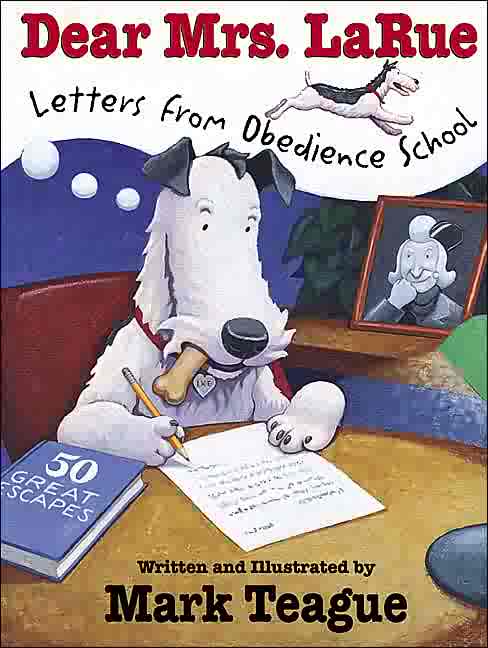
When evaluating children’s books it is important for teachers to keep in mind that some English Language Learners might lack the background knowledge necessary for understanding texts.  This week I evaluated The True Story of the Three Little Pigs by Jon Scieszka and Dear Mrs. LaRue Letters from Obedience School by Mark Teague. Each book was evaluated for components that might affect comprehension.


Dear Mrs. LaRue Letters from Obedience School by Mark Teague

1.      Difficulty: The student might not understand the format of the book.  English Language Learners may be confused that it is not written in a typical story format.  Also, they may not be familiar with written correspondence. 
Solution: The teacher can explain that this book is not written in the same format of a typical story.  The teacher can show the students that even though the text is written using letters, it still tells a story.
2.      Difficulty: English language learners may not have background knowledge of obedience school or prisons.  They may struggle with the concept of sending a dog off to an “academy”.
Solution: The teacher can pre-teach the concept of boarding schools.  The teacher can explain the use of boarding schools as well as animal obedience schools.
3.      Difficulty: ELL students may struggle to identify that Ike is exaggerating.  Ike says one thing, but the pictures show another. 
Solution:  Teachers can help English Language Learners see that Ike is being dramatic by pointing out the differences between the pictures and Ike’s letters.  The use of visuals and the teacher thinking aloud will help students understand the differences.  Furthermore, conversation with a partner about Ike’s letters and conditions would help develop language and understanding.
4.      Difficulty: Some ELL students may have difficulty separating the real and imaginary elements of the story.
Solution: Help students see how the author blends behaviors or real dogs into an imaginary story.  The teacher can help students separate the behavior of real dogs and make-believe dogs.  This can be done with the use of a graphic organizer on the board that is filled out throughout and after the story.  A teacher could also use a video to show typical dog behaviors.
The True Story of the Three Little Pigs by Jon Scieszka

1.      Difficulty: If English Language Learners do not know the story of the three little pigs then they will struggle to understand The True Story of the Three Little Pigs or the significance of the story.
Solution: Teachers can be sure to give the opportunity to read the original The Three Little Pigs story before The True Story of the Three Little Pigs.
2.      Difficulty: English Language Learners might not understand the concept of a fractured fairy tale.
Solution: After ensuring that all students have read the original The Three Little Pigs, teach students about fractured fairy tales.  Teachers should be sure to explain that the changes in The True Story of the Three Little Pigs makes it a fractured fairy tale.
3.      Difficulty: Students may understand some of the vocabulary and phrases used in the story.  Phrases: rude little porker, what a pig, brains of the family, your old granny can sit on a pin, jazzed the story up, the big bad wolf, once upon a time time, jazz it up, and second helping.
Words: framed, huffed, puffed, cheeseburger, and spoil
Solution: Pre-teach these unfamiliar phrases using pictures and demonstrations prior to reading, and reiterate meanings as necessary during reading.
4.      Difficulty: English Language Learners might not understand that straw and sticks are not good building materials for a house. 
Solution: A teacher could set up a mock demonstration showing the strength of straw and sticks.  As an alternative, the teacher could have straw, sticks, and a brick to illustrate the differences between the building materials.


References
Scieszka, J. (1989). The true story of the 3 little pigs. New York, NY: Viking Kestrel.
Teague, M. (2002). Dear Mrs. LaRue: Letters from obedience school. New York, NY: Scholastic Press.

Thursday, May 7, 2015

Decoding Unfamiliar Text

Have you ever tried to read a text in another language?  

Reading a novel written in Spanish was a very unpleasant experience, but a very important one.  The frustration I experienced during this activity allowed me to develop even more empathy for the English Language Learners in my classroom.  For this activity I located a Spanish novel called La Regenta by Leopoldo Alas.  The full version of this text can be found at: http://www.donquijote.org/spanishlanguage/literature/library/laregenta/

What was the text about?

I gathered from the picture and title that this text was about a woman.  I predicted that this story would be about her life.  I thought since many Spanish words are similar to English words that I would be able to gather some meaning from the text.  However, I could not have been more wrong.  I was shocked at how little of the text I could understand. 

What did I do to make meaning?

In order to make meaning of the text I started with a small section. I tried to use background knowledge.  I thought of words our Spanish teacher has used on the announcements, or during conversations with students.  I was able to guess the meanings of a few words based on this limited knowledge, but other than that I was completely lost.  I kept rereading the text hoping something would come to me, but I continued to be overwhelmed.  Ultimately, I realized I had very few strategies for comprehending the text.  I did not know the meanings of the words, so I thought of giving up.  I thought to myself that there was no way to make meaning of the text if I knew none of the words.  Then, I decided to try to look for patterns in the sentences to determine syntax and word meaning.  I think I determined which words were transitions, nouns, and adjectives based on syntax, but I still had no idea what they meant.  In order to understand what I was reading I had to scale back to the word level.  I finally resorted to using a translator to look up individual word meanings.  I then combined that knowledge with my knowledge of syntax to try to understand the story.  This process was labor-intensive, and not very efficient.

Strategies Used to Make Meaning
  • Use background knowledge.
  • Focus on a small section first.
  • Reread text.
  • Use relationship between English and Spanish to determine word meaning.
  • Examine syntax for clues.
  • Use a dictionary to look up unknown words.
What did I learn from this experience?

Not only did I develop more compassion for ELL students, but I was able to have a first-hand experience that illustrated the need of scaffolding.  I have always learned about the importance of providing scaffolding, but I never experienced the need of scaffolding until this activity.  I kept thinking to myself that if there would have been appropriate scaffolding in place that I might be able to get some meaning out of the text.  I graduated with an ESOL endorsement, and learned the importance of scaffolding instruction for ELL students.  However, I never knew what it felt like to learn a new language.  Now, I know the frustration that comes along with reading in a foreign language without the appropriate level of scaffolding.  In the future, I will be thoughtful of what my students go through when learning a new language.

What are the implications to teachers?
  • Teachers must provide appropriate scaffolding for students so that it is possible for them to comprehend the text.  Scaffolding instruction before, during, and after reading is crucial to success.  Actively engaging students in this process is also important (Irjuo, n.d.). 
  • Teachers should provide nonverbal support for reading (Irjuo, n.d.).  Pictures, diagrams, real objects, gestures, and graphic organizers help students understand a passage (Irjuo, n.d.). 
  •  Teachers should not give students the same activities as everyone else.  Teachers need to implement a curriculum at a language level that is accessible to ELLs (Irjuo, n.d.).  Also teachers should give more time for students to decode and comprehend texts.
  • Teachers should plan interactive activities around reading and interpreting texts.  Sharing ideas, comparing perspectives, and coming to agreement are ways for students to process language, which leads to reading comprehension (Irjuo, n.d.). 

References


Irujo, S. (n.d.). What Does Research Tell Us About Teaching Reading to English Language Learners? Retrieved May 7, 2015.

Saturday, May 2, 2015

Oral Language and Reading for ELL Students

The development of oral language provides a foundation for reading.  Oral language provides an opportunity for students to develop vocabulary knowledge, develop knowledge about linguistic rules, and learn the patterns of English (Freeman & Freeman, 2004).  Essentially, oral language and the reading process go hand-in-hand.  Students are able to find patterns in oral communication, and use this knowledge to understand and produce messages (Freeman & Freeman, 2004).  When English Language Learners use this knowledge to produce messages they process the language more deeply, and push their knowledge of language (Gibbons, 2002).

The reading process requires skills that are taught.  Students must learn skills to decode the words on the page.  However, oral language makes the transition much easier.  Once students decode the printed words on a page, they will recognize them as words in their oral language (Freeman & Freeman, 2004).  Students who have a strong foundation of oral language are likely to have an easier time learning to read, as they will already have knowledge of words and their meanings.  In other words, oral language helps students make sense of the words they are decoding, which leads to the ultimate goal of comprehension.

Knowing that oral language and learning to read go hand-in-hand, teachers must best support their ELL students by teaching these skills together.  Students must have opportunities to practice listening, speaking, and reading skills in order to become proficient at a second language.  Classroom talk needs to be deliberately and systematically planned so that it pushes second language development (Gibbons, 2002).  Keeping oral language and the reading process in mind when structuring tasks, setting up group work, and responding to students can foster second language development.  After all, as stated by Gibbons (2002): “Talk is how education happens!” (p. 38).

Freeman, D., & Freeman, Y. (2004). Written and Second Language Acquisition. In Essential linguistics: What you need to know to teach reading, ESL, spelling, phonics, and grammar. Portsmouth, NH: Heinemann.

Gibbons, P. (2002). Scaffolding language, scaffolding learning: Teaching second language learners in the mainstream classroom. Portsmouth, NH: Heinemann.

Writing Instruction

While it is difficult to remember the early years of writing instruction I received, I know my experiences most closely aligned with the learning view.  My teacher had a traditional writing classroom, where direct instruction was used to teach the aspects of writing.  Instruction started with the parts of writing, and then eventually we wrote whole texts (Freeman & Freeman, 2004).  However, we never began with a message.  We always learned the skills, and then worked on actual writing.  I wonder how much better of a writer I would have been in my early years if I would have been encouraged to start with a message, and then taught the skills needed to publish my thoughts.  I was always directly instructed to combine words into sentences, but never taught the power and beauty that language can convey.  Upon reflecting on this experience I realize that I am more of an inspired writing teacher, ensuring my students do not miss out on the writing instruction I did.  It is almost as if I am making up for lost experiences in my own writing instruction.  Teaching writing from an acquisition view is exciting and refreshing, and helping students express themselves in writing is invigorating. 


Freeman, D., & Freeman, Y. (2004). Written and Second Language Acquisition. In Essential linguistics: What you need to know to teach reading, ESL, spelling, phonics, and grammar. Portsmouth, NH: Heinemann.

Philosophies on Teaching English Language Learners

Discussing teaching philosophies is very beneficial.  I always enjoying hearing others viewpoints on education, and using these discussions to further strengthen my own philosophy.  This week I sat down with a colleague to discuss her viewpoints on teaching literacy to English Language Learners.  The conversation was very insightful. 

I found that my colleague strongly believes in providing English Language Learners with a supportive learning environment, helping them develop literacy through meaningful activities, and meeting their needs to succeed in the English academic environment. She aims to make the learning process meaningful by considering students’ prior knowledge, relationships, values, and experiences.  She also finds the value in having English Language Learners actively participate in classroom activities to develop literacy, rather than passively learn.  She also believes that when teaching literacy to English Language learners it is crucial to create a friendly, supportive learning environment, where students are comfortable experimenting with a new language without fear of making mistakes.  Keeping in mind the affective filter, Mrs. Merry knows it is crucial to do her best to keep anxiety, stress, and tension from interfering with a learner’s ability to learn. 

Mrs. Merry also believes that when teaching literacy to English Language Learners it is imperative to use appropriate approaches, methods, and techniques.  She compared preparing English Language Learners for a reading task to packing for a camping trip.  She spoke to how you always double check to make sure you have everything you need to have a great trip, so when planning instruction you should always double check that ELLs have everything they need to comprehend the text. 

Lastly, Mrs. Merry ended our discussion with by reminding me to always consider the power of scaffolding, classroom talk, collaborative groups, and think-alouds when working with English Language Learners.